Gutenberg har rätt många böcker för barn, med förslag på hur man sysselsätter sig. Dagens fynd riktar sig till flickor, naturligtvis med en baktanke att de små flickorna en dag ska bli goda och driftiga husmödrar.
Det är en bok med över 600 illustrationer, och så många förslag på vad man kan göra, att jag sannerligen inte vet hur jag ska kunna välja bara några få exempel.
Men vävning känns som ett bra och naturligt ställe att börja. Jag uppfattar boken som grundlig och informativ, men som alla böcker av det här slaget, är det nog en fördel om det finns en vuxen person som kan ge en hand — både i teori och praktiv.
 T is easier than sewing or knitting or crocheting, and comes so natural to many of us that one would almost think we should know how to weave without being taught. Why, even some of the birds do a kind of weaving in their pretty, irregular fashion, and it was probably from the birds and other small, wild creatures that the earliest human mothers took their lessons in weaving, and learned to make the mats for their babies to sleep on and baskets for carrying their food. No one knows how long ago these first baskets and mats were woven, but in the beginning weaving was done without looms. Afterward rude frames were tied together and hung from the limbs of trees, then softer and more flexible material was used and finer fabrics were woven. To this day almost the same kind of looms are used by the Indians in our far Western country, many miles away from the roar and clatter of machinery, and on them are woven the wonderfully beautiful Navajo blankets for which Eastern people are willing to pay such large sums.

I det här kapitlet får man lära sig att göra en enkel vävram och vävstickor — och sedan förslag på enkla projekt.
Bokens första del ägnas åt praktiska projekt — hantverk — att tillverka saker, som kanske närmast kan beskrivas som hobbyarbeten. Medan andra hälften av boken kallas rekreation, och inkluderar lekar och liknande sysselsättningar.
Vad barn leker i dag, har jag ingen aning om, men jag tror nog att de flesta i min generation lekt affär — även om vi nöjde oss med enklare doningar än vad som föreslås här. Jag kan tänka mig att tunnor är en bristvara i dag, men boken föreslår att man kan lägga en skiva över ett par stolar om inga tunnor finns att tillgå.
Jag tycker att boken tar fasta på, vad jag minns som väsentligt, från barndomens lekar — allt skulle vara så "riktigt" som möjligt. Något som vi sällan uppnådde när vi lekte på egen hand. På barnkrubban däremot (södra KFUK), en osannolikt pedagogisk inrättning, tillgodosågs vår längtan efter ett vuxenliv i miniatyr.
Den här boken visar hur man tillverkar allt man behöver i sin affär, från våg, varor, pengar och en strut att lägga det inköpta i.
Man lär sig att vika en portmonnä till sina hemgjorda pengar medan jag hittade beskrivningen till korgen i bokens första avdelning.
If you find that you need more and a greater variety of candy
manufacture it of strips of bright-colored paper rolled into the form of paper lighters about the length and thickness of ordinary stick candy. These mingled together in a separate glass jar or piled upon the counter add to the attractiveness of the store. Hard lump candy of various-sized pebbles will probably sell well, but if upon trial the demand is not as great as desired, you might wrap each pebble in a bit of bright paper to enhance its appearance; then the customers will doubtless invest more liberally in the gay-colored sweetmeats. Small candy balls, red and white, may be made of the red and[318] white clover-heads picked close to the blossom, leaving no sign of the green stem visible. Keep the different colors separate, placing all of the red clover candy flat down in one layer on the inside of a box-lid, where it will look bright and pretty. The upturned edges of the lid prevent the clover from rolling out. White-clover candy will appear to better advantage if you place a piece of colored tissue-paper in a box-lid, allowing the edges of the paper to stand up a trifle beyond the sides before arranging the white clover in the lid. Gather a variety of grasses, roots, and leaves, tie them up in little bunches with strings formed of several pieces of long grass twisted or braided together, and sell them as soup-seasoning herbs. Large bouquets of white clover-blossoms with long stems and no leaves when bunched together, forming a white mass on the top, and then surrounded by large green leaves tied in place with braided grass, make excellent imitations of cauliflowers. Use the round, flat hollyhock-seed for crackers; peel off the outside green cover and the crackers will be white. You can pretend large-sized poppy-seed vessels are green tomatoes, which your customers will be glad to buy for making pickles. Have everything connected with your[319] store neat and orderly, and conduct it in a business-like manner.
Do not forget to make bars of soap of moist clay or earth. Have the clay only soft enough to mould and cut with an old knife; when of the right consistency form the cakes, making them all the same size. Cut the edges smooth and even and lay the soap on a board in the sun to harden sufficiently to handle with ease.
You might also use moist clay for butter, and cut off portions as customers call for it, weighing the butter in your scales to obtain the exact quantity desired by each purchaser. Now try and think of other supplies you can make of the moist clay.

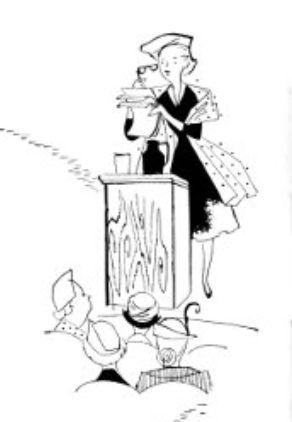
 I avdelningen "Modern Granny" får vi se en mormor som föreläser för kvinnorna i sin klubb (min tolkning), går till frissan,
 läser medan hon dammsuger och besprutar en buske i sin trädgård, med en flitspruta (förhoppningsvis inte med DDT.