Visar inlägg med etikett arnim v.. Visa alla inlägg

onsdag 22 maj 2019

Till maskrosens lov

Tre pojkar med ränsel
de ser hundviol
och samlar.
Jag hör hund som skäller
och min näsa luktar
morgon.
Som i Linnaeusvåren
maskros hundviol stellaria
vårbjörklöv och älskog.
Sol
 harsyrblad och blommens fjun.
                                     ur Kiri-ra! 
                                                 av Gunnar Björling

"Pine Trees and Dandelions in the Garden of Saint-Paul Hospital" 
Vincent Van Gogh

Många är de konstnärer, diktare och författare som låtit sig inspireras av den glada och nyttiga maskrosen. Jag kom att tänka på det i dag när maskrosfjunen snöade över nejden, så det såg ut som ett julkort. Ibland kallas den kusblomma och ibland gullborste, vilket bara är ett par av dess dialektala namn, andra äldre namn är lejontand, äggblomster, smörblomster, munkhuvud, skallnacke och kopiss. Både ordet kuse och mask användes förr om ohyra av olika slag, och först 1802 förekommer ordet maskros i tryck, då i "Svensk botanik".

Dandelions
Isaak Iljitsch Lewitan

How happy I was! I don't remember any time quite so perfect since the days when I was too little to do lessons and was turned out with sugar on my eleven o'clock bread and butter on to a lawn closely strewn with dandelions and daisies. The sugar on the bread and butter has lost its charm, but I love the dandelions and daisies even more passionately now than then, and never would endure to see them all mown away if I were not certain that in a day or two they would be pushing up their little faces again as jauntily as ever. During those six weeks I lived in a world of dandelions and delights. The dandelions carpeted the three lawns,-- they used to be lawns, but have long since blossomed out into meadows filled with every sort of pretty weed,-- and under and among the groups of leafless oaks and beeches were blue hepaticas, white anemones, violets, and celandines in sheets. The celandines in particular delighted me with their clean, happy brightness, so beautifully trim and newly varnished, as though they too had had the painters at work on them. Then, when the anemones went, came a few stray periwinkles and Solomon's Seal, and all the birdcherries blossomed in a burst. And then, before I had a little got used to the joy of their flowers against the sky, came the lilacs--masses and masses of them, in clumps on the grass, with other shrubs and trees by the side of walks, and one great continuous bank of them half a mile long right past the west front of the house, away down as far as one could see, shining glorious against a background of firs. When that time came, and when, before it was over, the acacias all blossomed too, and four great clumps of pale, silvery-pink peonies flowered under the south windows, I felt so absolutely happy, and blest, and thankful, and grateful, that I really cannot describe it. My days seemed to melt away in a dream of pink and purple peace.


Prydlig pärlemorfjäril

Insekter och fåglar i största allmänhet, och pärlemorfjärilar i synnerhet, gillar att festa på maskrosnektar  så vårda dina maskrosor! Hela plantan går att äta, och är till på köpet smockfull av vitaminer (A, C och K) och nyttigheter som kalk, kalium, järn och mangan.
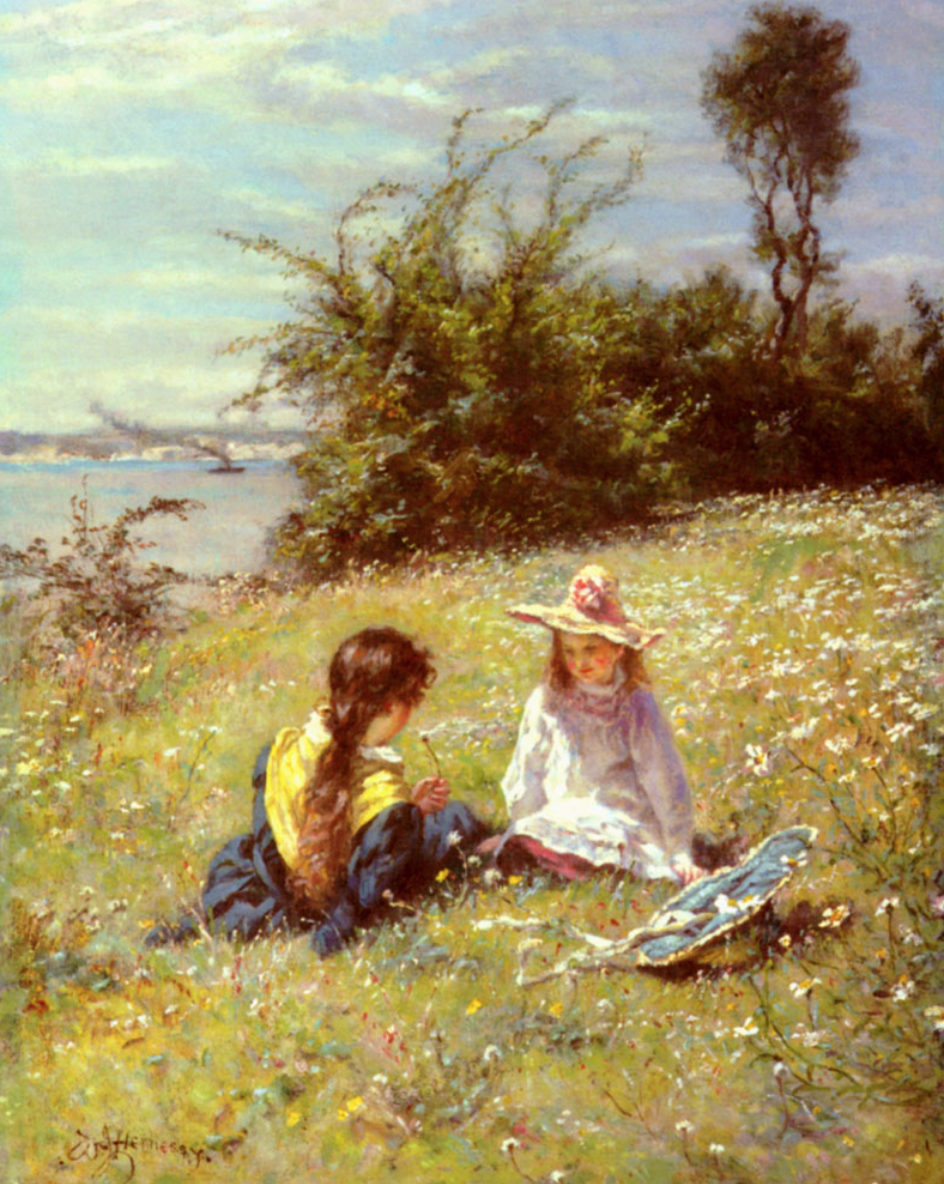
The Dandelion Clock 
H William John Hennessy 

 Every child knows how to tell the time by a dandelion clock. You blow till the seed is all blown away, and you count each of the puffs—an hour to a puff. Every child knows this, and very few children want to know any more on the subject. It was Peter Paul’s peculiarity that he always did want to know more about everything; a habit whose first and foremost inconvenience is that one can so seldom get people to answer one’s questions.

Och vem har inte gjort kedjor av maskrosstjälkar, något som inte var så uppskattat av våra mammor, eftersom mjölksaften ger fula fläckar på kläderna. En saft som man förresten kan göra gummi av.


“What I need is the dandelion in the spring. The bright yellow that means rebirth instead of destruction. The promise that life can go on, no matter how bad our losses. That it can be good again.” 
                                                                            Suzanne Collins


onsdag 25 juli 2018

Sommarläsning

What a blessing it is to love books. 
Everybody must love something, 
and I know of no objects of love that 
give such substantial and unfailing 
returns as books and a garden. 

Reading in the Garden, Pompeo Mariani

May 2nd.—Last night after dinner, when we were in the garden, I said, "I want to be alone for a whole summer, and get to the very dregs of life. I want to be as idle as I can, so that my soul may have time to grow. Nobody shall be invited to stay with me, and if any one calls they will be told that I am out, or away, or sick. I shall spend the months in the garden, and on the plain, and in the forests. I shall watch the things that happen in my garden, and see where I have made mistakes. On wet days I will go into the thickest parts of the forests, where the pine needles are everlastingly dry, and when the sun shines I'll lie on the heath and see how the broom flares against the clouds. I shall be perpetually happy, because there will be no one to worry me. Out there on the plain there is silence, and where there is silence I have discovered there is peace."

Jag var helt övertygad om att jag skrivit om Elizabeth von Arnim tidigare — tydligen är det ett av många inlägg jag bara tänkt skriva. För ögonblicket hänger jag mig åt den perfekta sommarläsningen, hennes "The Solitary Summer". En kort bok, som går alldeles för fort att läsa ut.

The first two years I had this garden, I was determined to do exactly as I chose in it, and to have no arrangements of plants that I had not planned, and no plants but those I knew and loved; so, fearing that an experienced gardener would profit by my ignorance, then about as absolute as it could be, and thrust all his bedding nightmares upon me, and fill the place with those dreadful salad arrangements so often seen in the gardens of the indifferent rich, I would only have a meek man of small pretensions, who would be easily persuaded that I knew as much as, or more than, he did himself. I had three of these meek men one after the other, and learned what I might long ago have discovered, that the less a person knows, the more certain he is that he is right, and that no weapons yet invented are of any use in a struggle with stupidity. The first of these three went melancholy mad at the end of a year; the second was love-sick, and threw down his tools and gave up his situation to wander after the departed siren who had turned his head; the third, when I inquired how it was that the things he had sown never by any chance came up, scratched his head, and as this is a sure sign of ineptitude, I sent him away.

Skriven i dagboksform består den av ungefär lika delar böcker och trädgård — och hennes tankar om bådadera. Det är välgörande att läsa hennes åsikter om böcker och författare, som känns så äkta, inget skrytrabblande av vad hon har läst eller redogörelser av snobbiga trädgårdsarrangemang — bara ett stillsamt filosoferande. Lägg till det de tre unga döttrarnas nöjsamma teologiska samtal, och hennes egna tankar om sina möten med de fattiga arbetarna i byn där hon bor.


May 15th.—There is a dip in the rye-fields about half a mile from my garden gate, a little round hollow like a dimple, with water and reeds at the bottom, and a few water-loving trees and bushes on the shelving ground around. Here I have been nearly every morning lately, for it suits the mood I am in, and I like the narrow footpath to it through the rye, and I like its solitary dampness in a place where everything is parched, and when I am lying on the grass and look down I can see the reeds glistening greenly in the water, and when I look up I can see the rye-fringe brushing the sky. All sorts of beasts come and stare at me, and larks sing above me, and creeping things crawl over me, and stir in the long grass beside me; and here I bring my book, and read and dream away the profitable morning hours, to the accompaniment of the amorous croakings of innumerable frogs.

Thoreau has been my companion for some days past, it having struck me as more appropriate to bring him out to a pond than to read him, as was hitherto my habit, on Sunday mornings in the garden. He is a person who loves the open air, and will refuse to give you much pleasure if you try to read him amid the pomp and circumstance of upholstery; but out in the sun, and especially by this pond, he is delightful, and we spend the happiest hours together, he making statements, and I either agreeing heartily, or just laughing and reserving my opinion till I shall have more ripely considered the thing. He, of course, does not like me as much as I like him, because I live in a cloud of dust and germs produced by wilful superfluity of furniture, and have not the courage to get a match and set light to it: and every day he sees the door-mat on which I wipe my shoes on going into the house, in defiance of his having told me that he had once refused the offer of one on the ground that it is best to avoid even the beginnings of evil.  But my philosophy has not yet reached the acute stage that will enable me to see a door-mat in its true character as a hinderer of the development of souls, and I like to wipe my shoes. 

Gutenberg har många av Elizabeths böcker — ta en titt på dem, jag har funnit alla jag läst läsvärda.

 I know what I would do if I were both poor and genteel—the gentility should go to the place of all good ilities, including utility, respectability, and imbecility, and I would sit, quite frankly poor, with a piece of bread, and a pot of geraniums, and a book. 

söndag 20 maj 2018

Ljuvliga sommar

Albert Claes-Thobois


“What a blessing it is to love books.” 
                                                  Elizabeth von Arnim
                                                                  The Solitary Summer

måndag 4 april 2011

Grattis Bettine!


Bettine von Arnim
4 april 1785 – 20 januari 1859

Bettine (ofta stavat Bettina) vars fullständiga namn var Elisabeth Catharina Ludovica Magdalena Brenanto, har länge varit mest känd för att hon umgicks med storheter som Goethe och Beethoven.
Hon hade många strängar på sin lyra, hon var konstnärlig, målade och tecknade, musikalisk, hon komponerade och sjöng, förutom att hon var författare. Dessutom var hon okonventionell och tycks ha gjort vad hon behagade. Hon stod på de förtrycktas sida — och inte bara talade i deras sak, utan i hela sitt liv gav hon både tid och pengar för att de skulle få det bättre.
Hennes bror, Clemens Brentano, var en välkänd poet, och 1811 gifte hon sig med sin brors bästa vän, författaren Achim von Arnim.